Commercial Seeding or Turf Laying? How Swansea Businesses Can Choose the Right Option for Worn Grass Areas
When a grass area outside commercial premises starts thinning, breaking up or turning muddy, the next question is usually this: commercial seeding or turf laying? For Swansea businesses, the right answer depends on more than budget alone. Footfall, presentation standards, timescales, soil condition and how quickly the area needs to recover all matter. At Matthew Thomas Landscapes, we help commercial, industrial and business clients assess worn grass areas properly so the chosen solution fits the site rather than simply covering the problem.
From our base in Pontarddulais, Swansea, we provide seeding, turf laying, turf and soil supplies, grounds maintenance and wider soft landscaping support. That means we can look at the bigger picture and recommend the most practical option for each site.
Why the choice matters on commercial grounds
On business premises, worn grass is rarely only a cosmetic issue. Bare patches at entrances, office frontages, shared developments or industrial sites can quickly affect first impressions and make the wider exterior feel harder to manage.
If the wrong reinstatement method is chosen, businesses can end up with slower recovery, repeat patching or a surface that still struggles under everyday use.
Presentation suffers when thin grass, exposed soil and muddy edges are visible to staff, visitors and customers.
Usability drops when grass cannot cope with routine footfall or site movement.
Maintenance demands rise if the area needs repeated attention because the original cause was not addressed.
Costs can increase when a quick fix leads to further repair work later.
That is why the decision between seed and turf should be made around the condition and purpose of the area, not only the initial price.
Commercial Seeding or Turf Laying: What Is the Difference?
Both methods aim to restore worn grass, but they do it in different ways.
Commercial seeding
Seeding involves preparing the ground and establishing new grass from seed. It can be a sensible option for larger areas or sites where there is time for the grass to develop gradually.
Usually more cost-effective in material terms for broader areas
Useful where the site can be protected during establishment
Well suited to reinstatement work that does not need an instant finished look
Flexible for blending into surrounding grassed areas
Commercial turf laying
Turf laying involves installing pre-grown grass onto prepared ground. It gives an immediate green finish and is often preferred where presentation matters straight away.
Creates a faster visual improvement
Helps restore a more uniform appearance quickly
Often better for high-profile areas near entrances or customer-facing frontages
Can make sense when project timescales are tighter
Neither option is automatically right in every case. The better choice depends on how the area is used, how visible it is and whether the ground underneath is ready for successful reinstatement.
When commercial seeding is often the better fit
Commercial seeding can be the stronger option when the area is relatively large, the business has some flexibility on appearance during establishment and access can be managed while the grass develops.
Seeding may suit your site if:
The worn area is broad rather than highly localised
The location is less prominent than a main entrance or reception frontage
You want a practical reinstatement option with lower upfront material costs
The site can allow time for grass to establish before heavy use resumes
Why some businesses choose seed
For wider verges, peripheral grass areas or sections that do not need to look complete immediately, seeding can be a sensible commercial choice. It allows recovery across a bigger footprint without the higher initial outlay that turf laying often brings.
Seed can also work well where the aim is to improve the overall condition of a site gradually as part of a broader maintenance or soft landscaping plan.
What to consider before choosing seed
It takes longer to achieve a dense, established finish
Timing and weather conditions matter more
Young grass can be vulnerable if access is not controlled
Ongoing aftercare is especially important in the early stages
In other words, seeding can be very effective, but it usually rewards patience and proper site management.
When turf laying is often the stronger choice
Turf laying is often the preferred option when a business needs a faster visual improvement or when the worn grass sits in a highly visible position. For customer-facing premises, office frontages and entrance verges, appearance and speed can make turf the more practical route.
Turf may suit your site if:
The area is close to entrances, visitor routes or prominent boundaries
You need the site to look tidier quickly
The worn section is localised enough to justify a more immediate finish
The grass forms part of a wider exterior upgrade with a set programme
Why businesses often prefer turf for visible areas
Commercial turf laying can restore a clean, consistent look straight away, which is important when first impressions carry weight. If a muddy patch is undermining the approach to the building, newly laid turf can make the space feel far more finished from day one.
Turf is also useful where a worn area is disrupting the appearance of otherwise well-kept grounds. Instead of waiting for seed to fill out, the site gains an immediate green surface once installation is complete.
What to consider before choosing turf
Material costs are usually higher than seeding
Ground preparation still has to be done properly
Fresh turf still needs aftercare while it roots in
If the original cause of wear remains, the problem can return
Turf is fast, but it is not a shortcut around poor preparation or repeated site stress.
The site factors that should decide the choice
1. Visibility of the area
If the grass is beside a main entrance, frontage or route used by customers and visitors, turf is often the stronger presentation-led option. If it is a secondary area away from the main approach, seeding may be entirely suitable.
2. Level of wear and ongoing footfall
If the area will continue to receive heavy use, neither seed nor turf should be chosen in isolation. The real question may be whether access needs to be redirected, the layout adjusted or the ground improved first. This is where an experienced site assessment adds value.
3. Programme and timescale
Seeding usually needs more time and the right growing conditions. Turf laying can create a faster visual result, which is often important when works form part of a scheduled exterior improvement project.
4. Ground condition
Compaction, poor levels, exhausted soil and old debris can all undermine new grass. We often combine reinstatement with grounds preparation and commercial landscaping work so the new surface is being installed on properly prepared ground.
5. Budget and long-term management
Seed may reduce initial material costs, while turf may reduce the visual downtime of the area. The right commercial decision is often about total practicality rather than the cheapest line item on the quote.
Preparation matters whatever option you choose
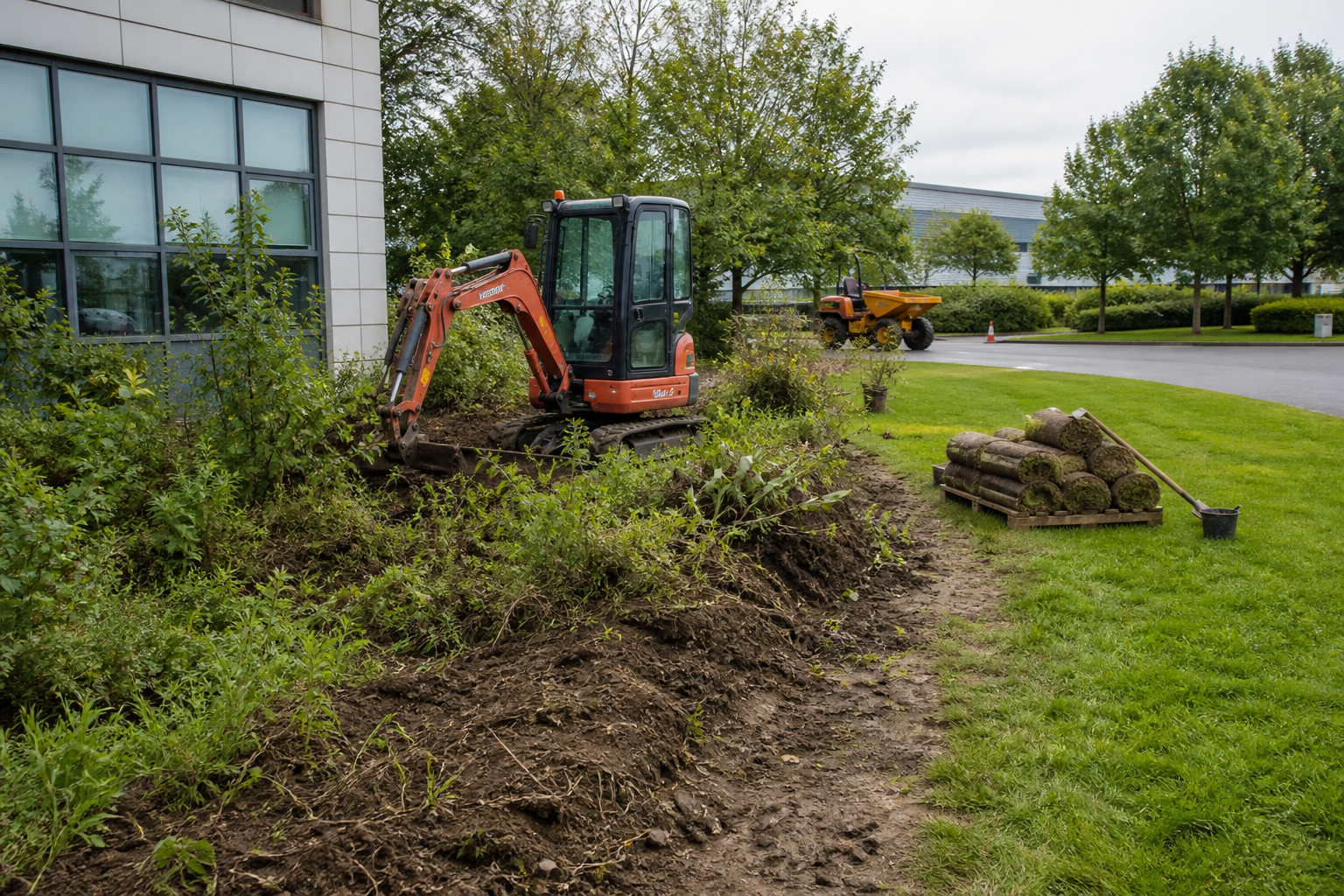
One of the biggest mistakes on worn grass areas is focusing on the finish before addressing the base. If the soil is compacted, levels are uneven or the site has been allowed to deteriorate too far, new grass will struggle whether it arrives as seed or turf.
Good preparation can include clearing failed material, relieving compaction, improving levels and bringing in suitable soil where needed. Where the existing surface is tired or inconsistent, our turf laying, seeding and soil supply services help businesses deal with the full job rather than only the visible top layer.
This is also where wider maintenance planning matters. A restored grass area will usually perform better when it sits within a sensible upkeep plan, supported by regular attention and early intervention before new wear becomes established. Our commercial grounds maintenance support helps clients keep restored areas looking consistent over time.
Why Swansea businesses ask us to assess the site first
Matthew Thomas Landscapes was established in 2004 and works with commercial, industrial and business clients from our base in Pontarddulais, Swansea. Because we provide seeding, turf laying, weed control, tree planting, fencing, consultancy and wider soft landscaping services, we can assess worn grass as part of the whole site rather than treating it as an isolated patch.
That broader view matters. In some cases, seeding is the sensible answer. In others, turf laying is more practical. Sometimes the real issue is that the ground needs more preparation before either option will last well. A proper site visit helps identify the most suitable route before time and money are spent on the wrong fix.
A simple way to decide between seeding and turf
Look at the location. Is the worn area highly visible or more peripheral?
Judge the timescale. Does it need to look finished quickly, or is there time for establishment?
Assess the cause. Is the wear down to traffic, compaction, poor levels or inconsistent maintenance?
Consider the scale. Is it a broad reinstatement area or a localised patch that affects first impressions?
Plan the aftercare. Can the site support the establishment period properly?
If any of those answers are unclear, a site assessment is usually the safest next step.
Frequently Asked Questions
Is seeding or turf laying better for heavy-use commercial grass areas?
It depends on how the area is used and whether the wear issue can be reduced. Turf often provides a faster visual improvement, but both seeded and turfed areas need time to establish. If traffic will continue in the same pattern, the ground may need wider improvement or layout changes as well.
How long does commercial seeding take to establish?
Seeding usually takes longer than turf to produce a full, resilient finish. Weather, soil condition, season and aftercare all influence the result. That is why seeding is often better where the site can allow more patience during the establishment period.
When should a Swansea business choose turf instead of seed?
Turf is often the stronger choice when the area is highly visible, the site needs to look presentable quickly or the worn patch is undermining an entrance or frontage. It is especially useful when appearance and programme are both priorities.
Do you need ground preparation before turf laying or seeding?
Yes. Proper preparation is essential for both. If the base is compacted, uneven or poor in quality, new grass can struggle to establish well. Preparation is often the difference between a short-term improvement and a longer-lasting result.
Can worn grass areas be repaired as part of wider commercial landscaping work?
Yes. Grass reinstatement often makes most sense when it is planned alongside other exterior improvements such as site clearance, soft landscaping, fencing or ongoing grounds maintenance. That joined-up approach can improve the overall finish and reduce repeat work later.
Book a site assessment for worn commercial grass areas
If you are deciding between commercial seeding or turf laying for a site in Swansea, the right choice will come from the condition of the ground, the visibility of the area and how quickly it needs to recover.
Book a site assessment with Matthew Thomas Landscapes to find out whether seeding or turf laying is the better fit for your commercial grounds. We will help you take a practical view of the site and choose an option that supports both presentation and long-term use.