Commercial Site Clearance and Grounds Preparation: A Practical Pre-Start Checklist
Commercial site clearance and grounds preparation can decide whether an external project starts smoothly or becomes harder and more reactive than expected. Before fencing, turfing, planting or wider landscaping works begin, businesses need a clear picture of what is on site, what needs to be removed and how the ground should be prepared for the next stage.
If you are planning improvements to business premises, early preparation helps protect timescales, presentation and budget control. At Matthew Thomas Landscapes, we work with commercial, industrial and business clients from our base in Pontarddulais, Swansea, delivering practical outdoor improvement works from initial preparation through to completion.
Why planning early matters before external works begin
On commercial premises, the groundwork affects everything that follows. If waste, overgrowth, unstable surfaces or poor levels are left unresolved, later stages can become slower, less efficient and more difficult to finish to a good standard.
This is why site clearance and grounds preparation should not be treated as an afterthought. They are the foundation of a well-managed external project.
Better programme control: early preparation helps avoid delays once the main works start.
Clearer scope: businesses can see exactly what needs to be retained, removed or improved.
Improved presentation: even the clearance stage can make a neglected area look more organised.
Stronger long-term results: fencing, turfing and soft landscaping perform better when the ground has been prepared properly.
More practical planning: access, storage, waste removal and work sequencing can be agreed in advance.
For property managers, developers and business owners, that early visibility makes decision-making easier. It also helps avoid paying for finish-stage work before the site is truly ready for it.
Commercial site clearance and grounds preparation: what businesses should review before work begins
1. Access, traffic and working space
Before any contractor starts, look at how the site is actually used day to day. A commercial project often has to fit around staff, visitors, deliveries, tenants or operational traffic.
Key questions include:
Where can vehicles, machinery and materials safely access the site?
Which entrances, loading areas or walkways must stay usable during the works?
Is there enough space for clearance, waste handling and material storage?
Will the work need to be phased to reduce disruption?
A site that looks straightforward on paper can become more complex once access restrictions and live operations are considered. That is why a pre-start review is so important.
2. Vegetation, waste and unwanted materials
Commercial clearance can involve more than cutting back overgrowth. Businesses often need to deal with mixed vegetation, redundant materials, uneven edges, tired planted areas and general site clutter before new works can begin.
The objective is not simply to strip everything back. It is to decide what should stay, what should go and what needs protecting during the next phase.
Overgrown boundaries may need clearing before new fencing lines are set out.
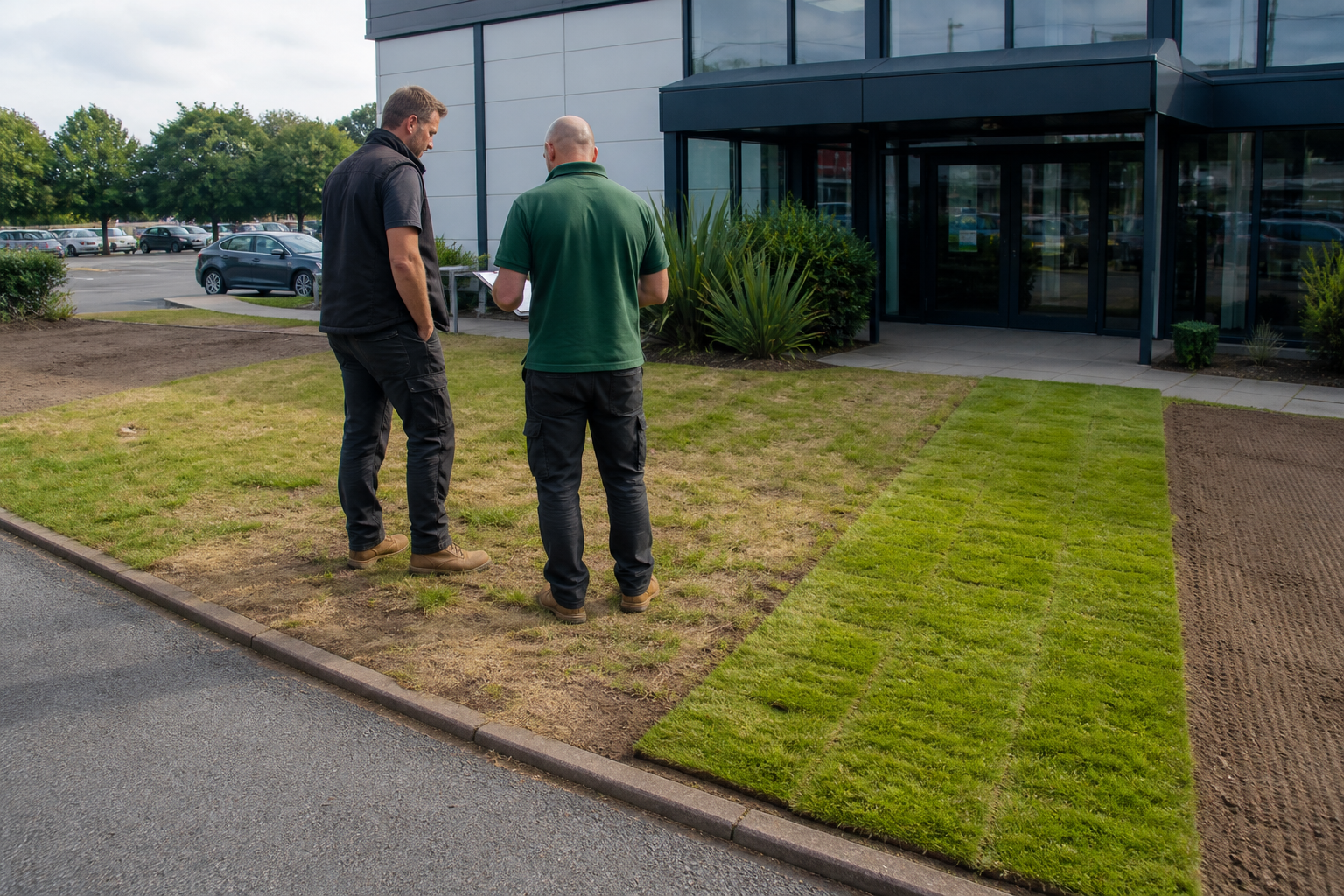
Worn grass and poor planting areas may need removing before turfing or soft landscaping.
Loose debris and outdated site features can interfere with layout, access and finish quality.
Heavy weed growth may need dealing with early so it does not undermine the final appearance.
Where external areas have been patched over time, this stage often reveals issues that were less visible before clearance began.
3. Ground levels, drainage and soil condition
Grounds preparation is about function as much as appearance. If levels are poor, drainage is weak or the soil condition does not suit the proposed finish, the final result may not perform as intended.
For example, new turf laid onto poorly prepared ground is unlikely to establish well. Boundary work can also be affected if lines are uneven or obstructed. In the same way, new soft landscaping needs the right base conditions to settle and perform properly.
Businesses should review:
Whether the site has low spots, ruts or uneven areas
How water currently moves across the space
Whether the soil is compacted, contaminated with rubble or lacking structure
How prepared areas will tie into paths, kerbs, entrances and existing surfaces
These are the details that influence finish quality later on.
4. Existing boundaries, edges and surface transitions
Ground preparation should also consider how one part of the site meets another. This is especially important where landscaped areas sit beside access routes, parking zones, paths or perimeter boundaries.
If businesses leave those edges undecided until late in the project, they often end up with awkward transitions, inconsistent lines or additional remedial work.
It helps to identify early:
Where new boundary lines need to be set out
Which sections of existing fencing are staying or being replaced
How turf, planted areas or soil beds will meet hard edges
Whether worn margins need reshaping before the finish stage begins
If your next phase includes fencing installation and boundary improvements, that planning should happen before clearance is complete, not after.
5. The scope of the next-stage works
One of the biggest planning mistakes is treating clearance as a separate job with no real connection to what comes next. In reality, the right preparation depends on the final objective.
If the project is leading into commercial landscaping services, the clearance approach should support the layout, levels and finish required for that scheme. If the site needs turf laying and seeding work, the ground needs preparing with that end use in mind.
This is why businesses should define the next stage early, even if the full project will be phased over time.
What a pre-start site visit should cover
A site visit is usually the best way to turn a broad idea into a practical scope of works. It gives both the client and contractor a clearer understanding of what the project involves before external works begin.
A useful pre-start review should cover:
The exact clearance area so everyone understands which sections are included.
Items to retain such as usable boundaries, established planting or access routes that must stay in service.
Removal priorities including vegetation, worn surfaces, waste or obstructive materials.
Ground preparation requirements for the next stage, whether that is turfing, fencing, planting or a wider upgrade.
Access and sequencing so the work can be planned around site operations where needed.
Expected finish standard to avoid gaps between what the business assumes and what the contractor has priced.
On live commercial premises, phasing can make a major difference. It may be more practical to clear one area, prepare it properly and move into the installation stage in sequence, rather than disrupting the whole site at once.
Common mistakes that delay commercial external works
Starting with the finish instead of the preparation
Businesses often focus first on how the completed site should look. That is understandable, but the finish-stage work depends on the condition of the ground beneath it. If preparation is rushed, later works can become harder to deliver properly.
Assuming all clearance is straightforward
Sites vary widely. A lightly overgrown frontage is very different from a tired multi-use exterior with redundant materials, uneven levels and several conflicting site functions. Early assessment helps avoid under-scoping the job.
Leaving boundary decisions too late
If fencing, edges or dividing lines are still undecided once the clearance stage is under way, the programme can slow down. Clear decisions on layout and boundaries help the groundwork support the final design rather than work against it.
Ignoring future maintenance
A site should not only look better on completion. It should also be manageable afterwards. Practical layouts, clear edges and sensible planting or turfing choices can make ongoing care much easier. That is where planned commercial grounds maintenance support can complement improvement works over the longer term.
How we support commercial site clearance and grounds preparation
At Matthew Thomas Landscapes, we provide landscaping and outdoor property improvement services for commercial, industrial and business clients. We are based in Pontarddulais, Swansea, have been established since 2004 and work on commercial projects across the UK.
Our work includes site clearance, grounds preparation, fencing installation, turfing, soft landscaping, weed control and grounds maintenance. We also manage wider external property improvement works, helping clients move from an unclear or neglected site condition to a more practical and professional finished environment.
Our approach is straightforward. We look at the site as a whole, consider what the next stage of work needs to achieve and plan the preparation around that outcome. That joined-up thinking is often what prevents avoidable delays, inconsistent finishes and reactive follow-on work.
Frequently asked questions
What does commercial site clearance and grounds preparation usually include?
It depends on the site, but it commonly involves clearing overgrowth, removing unwanted materials, preparing the ground for the next stage of works and making sure access, levels and boundaries are properly considered before landscaping, fencing or turfing begins.
When should commercial site clearance happen before landscaping works?
It should happen early enough for the contractor to identify any issues that could affect the next stage. If clearance is left too late, businesses may discover problems with access, levels or ground condition only after the main programme has started.
Can site clearance and grounds preparation be phased around a live business site?
Yes, in many cases it can. On occupied or operational premises, the work may be planned in sections so important access routes and working areas remain usable while improvement works progress.
Do commercial turf areas need proper grounds preparation first?
Yes. Worn or poorly prepared ground can affect how new turf establishes and how the finished area performs. Proper preparation helps create a better base for a healthier, more usable result.
Why is a site visit important before external works begin?
A site visit helps clarify the scope, identify constraints and align the preparation stage with the final objective. It is one of the most effective ways to avoid misunderstandings, delays and unnecessary reactive changes once work is under way.
Conclusion
Commercial site clearance and grounds preparation are the starting point for better external works, not a minor box-ticking exercise before the visible improvements begin. When the site is assessed properly, cleared with purpose and prepared for the next stage, businesses are in a far stronger position to achieve a practical and professional end result.
If you are planning work on business premises, request a site visit from Matthew Thomas Landscapes to discuss site clearance, grounds preparation and the next stage of your external works.